Weekly Mortgage Payments: Your Options and How to Set Them Up

Most homeowners pay their mortgage once a month because that's the default. If your paycheck lands every week, a monthly mortgage bill can feel out of sync with how your money actually moves.
Weekly payments are one alternative. But in the US, they're not widely offered. Most servicers support biweekly at most, and some only support monthly. Here's what's available, how the options compare, and how to set up the schedule that fits your pay cycle.
Mortgage Payment Frequency Options in the US
US mortgage servicers typically offer some combination of the following schedules. Not every lender offers all of them.
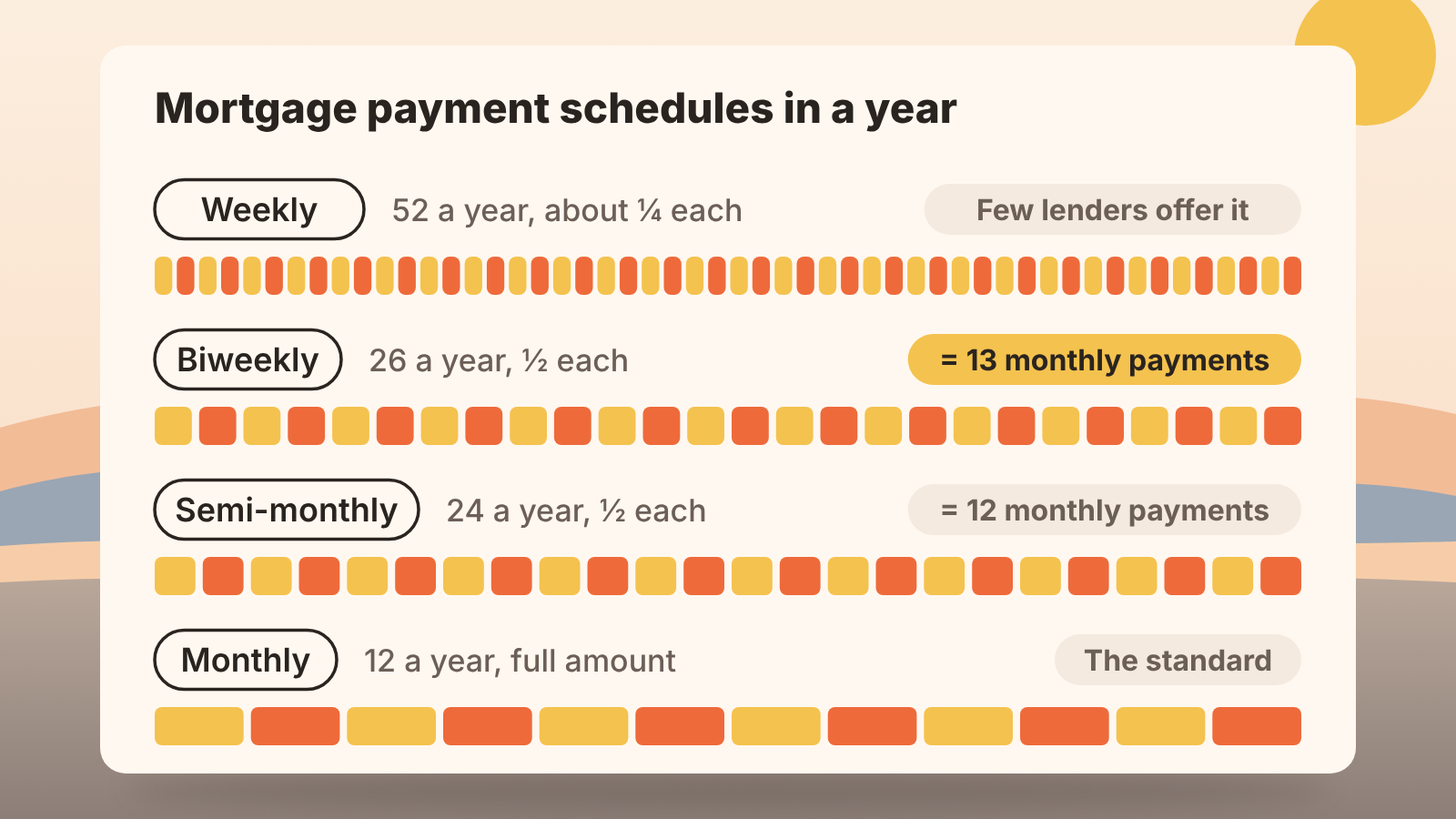
How the Options Compare
Using a $300,000 mortgage at 6.75% over 30 years. Monthly payment: approximately $1,946.
| Payment frequency | Payment amount | Payments per year | Annual outlay | Extra payments/year | Est. interest saved |
|---|---|---|---|---|---|
| Monthly | $1,946 | 12 | $23,352 | — | Baseline |
| Semi-Monthly | $973 | 24 | $23,352 | — | None |
| Biweekly | $973 | 26 | $25,298 | 1 | ~$90,000 |
| Weekly | $487 | 52 | $25,324 | 1 | ~$90,000 |
Semi-monthly produces identical results to monthly. Same annual outlay, no extra principal, no interest savings. It changes the timing, not the outcome.
Biweekly and weekly produce nearly identical long-term results. The difference between them is which pay cycle they align to.
The biweekly and weekly interest savings and payoff figures assume payments are applied to principal when received. If your servicer holds partial payments in a suspense account until a full monthly amount accumulates, the daily interest reduction disappears.
The extra annual payment still applies and the long-term savings remain, but the mid-cycle benefit is lost.
How to Set Up Your Payment Schedule
If your servicer offers weekly payments
A small number of US lenders support weekly payments as a formal enrolled program. Wells Fargo is one: their automatic draft option withdraws one quarter of the monthly payment every week at no charge, with extra funds applied to principal once the loan is one month ahead. Enroll directly through their online banking portal or payment enrollment form.
Before enrolling, confirm in writing whether payments are credited to principal on arrival or held until a full monthly amount accumulates. If the servicer holds partial payments, the daily interest benefit is lost.
If your servicer offers biweekly payments
Biweekly is the most widely available alternative to monthly across US servicers. Log in to your mortgage account, find the payment frequency or autopay settings, and switch to biweekly. Most lenders offer it free. Ask the same question about how payments are applied before switching.
If your servicer doesn't support either
Call your servicer and confirm what payment frequencies they support. If the answer is monthly only, two options produce comparable long-term results without program enrollment.
Make one extra full principal payment per year on your own schedule. Financially this is the equivalent of a biweekly or weekly schedule, and you choose when it happens.
Add a fixed amount to each monthly payment designated as principal. This gives direct control over payoff pace and can be adjusted or stopped at any time.
If the goal is timing, not payoff
Some borrowers just want their mortgage bill to land when they get paid. Split Pay splits your monthly mortgage payment into two smaller amounts timed to your pay cycle, without changing anything with your lender. The total stays the same.
Weekly Mortgage Payments FAQs
1. Does every US lender offer weekly mortgage payments?
No. Weekly is the least commonly supported payment frequency among US servicers. Most offer biweekly at most, and some only support monthly. Confirm with your servicer before planning around a specific schedule.
2. Is biweekly the same as semi-monthly?
No. Biweekly is 26 payments per year, equal to 13 monthly equivalents. Semi-monthly is 24 payments per year, equal to exactly 12. Biweekly reduces total interest, shortens the loan term, and builds equity faster. Semi-monthly does neither.
3. What happens if my servicer holds partial payments?
If your servicer places weekly or biweekly payments in a suspense account until a full monthly amount accumulates, the daily interest benefit is lost. Principal isn't reduced until month-end regardless of when individual payments arrived. The extra annual payment under biweekly or weekly still applies, but the mid-cycle savings do not. Confirm the application policy with your servicer before enrolling.
4. Will changing my payment frequency affect my credit score?
No. Payment frequency has no effect on your credit score. The only risk is if a servicer misapplies a partial payment and marks the account as late, which is why confirming the application policy before switching matters.
5. Are there fees for weekly or biweekly programs?
Usually not when set up directly through your servicer. Third-party services often charge enrollment and ongoing fees for a schedule change your lender may handle at no cost. Check with your servicer before paying anyone else to do it.
6. What if I just want my payment to align with my paycheck?
If your servicer doesn't support weekly or biweekly, or if you want more control over timing without changing your loan arrangement, Split Pay lets you split your monthly mortgage payment into two smaller amounts timed to your pay cycle. No lender coordination required.