How to Avoid Interest on a Car Loan: Smart Strategies to Pay Less

Negotiating the purchase price of a car is something most buyers prepare for. Reducing the total interest paid on the loan is something most don't, and over a five or six year term, that's often where more money is actually lost. On a $25,000 loan at 6% over five years, interest alone adds nearly $4,000 to the final cost.
There are only two ways to avoid car loan interest completely: cash, or a genuine manufacturer 0% APR promotion. For everyone financing, this guide covers exactly how to reduce what you pay, with strategies that work before you sign and others that apply to a loan you're already in.
Can You Really Avoid Car Loan Interest, and How?
Two routes eliminate interest entirely. Everything else is about reducing it.
Paying Cash
No lender means no interest. Paying cash puts every dollar toward the car itself, with nothing lost to financing costs. Most buyers can't or don't want to commit that much capital at once, but it's the only guaranteed way to pay zero.
0% APR Financing
Manufacturers occasionally offer 0% financing to clear specific models with excess stock. These deals are real, but the conditions matter. You typically need a credit score of 720 or above to qualify, and terms are usually shorter, 36 or 48 months, which means higher monthly payments than longer financing would produce.
There's often a trade-off with cash rebates too. On a $25,000 car with a $2,000 rebate available, taking the rebate and financing at your actual approved rate may cost less overall than a 0% deal over 36 months. The answer depends on your rate, so calculate total interest paid under both options before deciding.
How Car Loan Interest Builds Over Time
Car loans use a structure called amortization. Each payment covers both interest and principal, but the split between the two shifts over time. In the early months, the majority of each payment goes toward interest. As the balance falls, more of each payment goes toward principal.
On a $25,000 loan at 6% APR over 60 months, the monthly payment is $483.32. In month one, $125 of that is interest and $358 is principal. By month 30, the interest portion has dropped to roughly $69. By month 55, it’s under $15. The payment stays fixed, but what it's actually paying changes significantly.
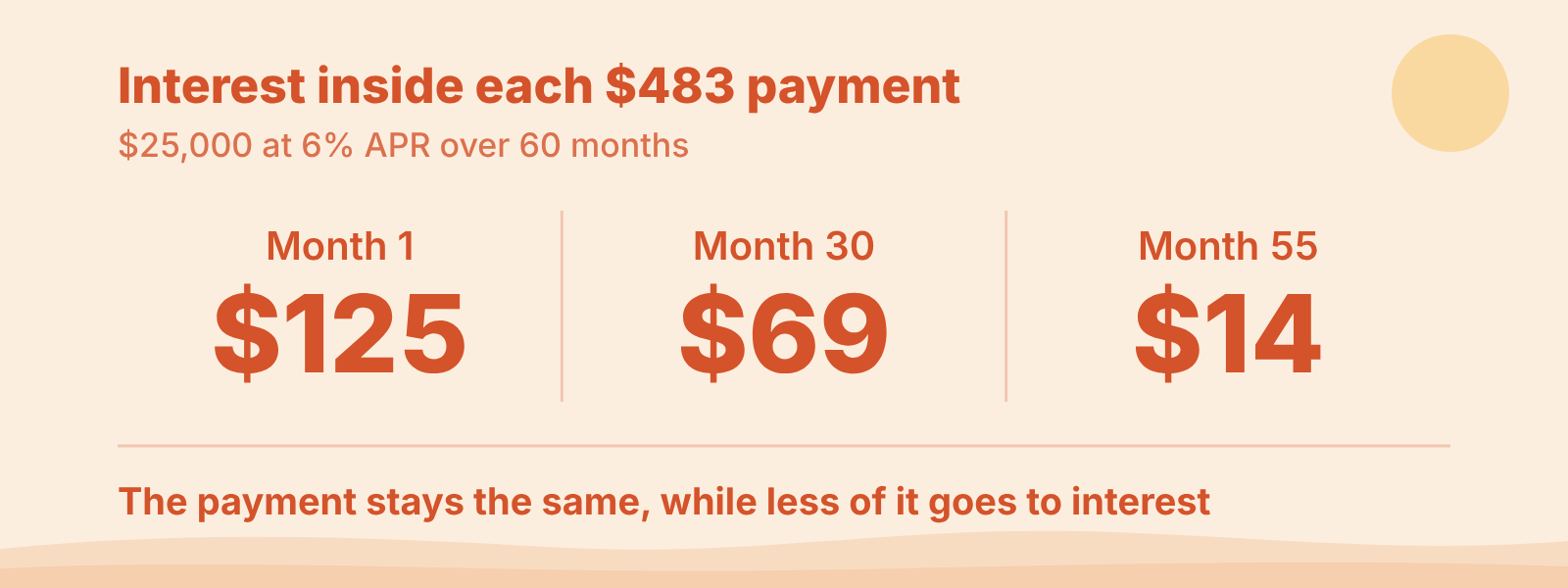
That's why extra payments made early save more than the same amount paid later. A lower principal means less interest calculated on every remaining month.
Longer terms amplify this considerably. The table below shows total interest paid on the same $25,000 at 6% across four common terms.
| Loan Amount / APR | Term | Monthly Payment | Total Interest Paid |
|---|---|---|---|
| $25,000 at 6% | 36 months | $760.55 | ~$2,380 |
| $25,000 at 6% | 48 months | $587.00 | ~$3,182 |
| $25,000 at 6% | 60 months | $483.32 | ~$3,999 |
| $25,000 at 6% | 72 months | $414.69 | ~$4,831 |
Figures are approximate. Use a loan amortization calculator for exact numbers based on your rate.
Same car, same rate. The only variable is time, and it accounts for a difference of about $2,450 between the shortest and longest term. Every strategy that follows works by reducing the interest rate, the principal, or the number of months interest has to accumulate.
How to Avoid Interest on a Car Loan Before You Buy
Five decisions made before signing have more impact on total interest than anything you can do afterward.
Improve Your Credit Score Before Applying
Your credit score is the primary factor lenders use to set your APR. The difference between a good score and an excellent one can be several percentage points, which translates directly into thousands of dollars over a loan term.
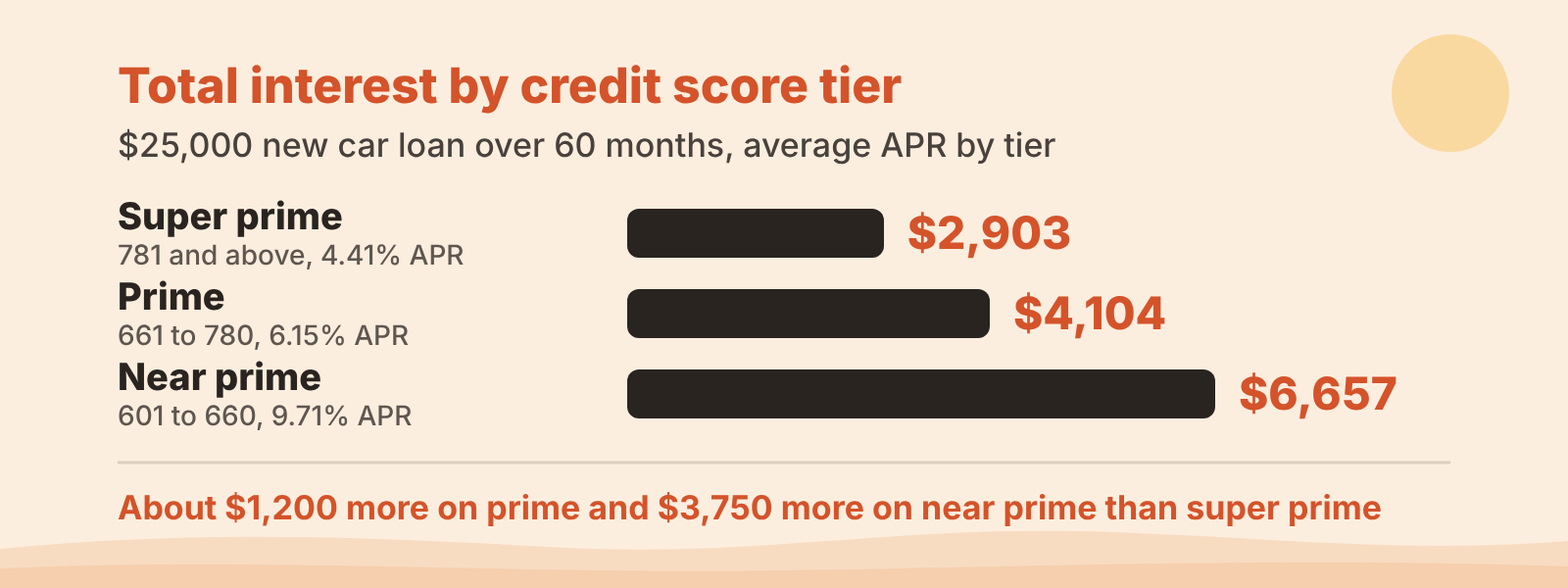
In Experian’s State of the Automotive Finance Market data for the second quarter of 2026, borrowers in the prime tier (661 to 780) paid an average of 6.15% on new car loans, while the super-prime tier (781 and above) paid 4.41%. On a $25,000 loan over 60 months, that 1.74-point gap costs about $1,200 in extra interest.
In the near-prime range (601 to 660), the average rate climbs to 9.71%, which adds about $3,750 compared with super prime.
Take these three steps before you apply:
1. Pull your credit report from all three bureaus and dispute any errors you find.
2. Pay down revolving balances, starting with any card above 30% utilization.
3. Hold off on new credit accounts in the months before you apply, since new inquiries and new accounts both lower your score for a while.
If you have 60 to 90 days before you buy, these moves can shift your score enough to put you in a better rate tier.
Compare Multiple Lenders
The rate a dealership offers is not necessarily the best rate available to you. Dealers often mark up financing above the rate the lender actually approved, keeping the difference as profit. It's legal, it's common, and it's avoidable.
Get prequalified with at least three lenders before you go to the showroom: your bank or credit union, one other bank, and at least one online auto lender. Credit unions in particular frequently offer rates below dealer financing for members. Most prequalification checks use soft pulls, so comparing multiple offers won't affect your credit score.
Walking in with a preapproval gives you a concrete rate to compare against whatever financing the dealer proposes. A competing offer also shifts the negotiating dynamic in your favor.
Make a Larger Down Payment
Interest accrues on the outstanding principal. A larger down payment reduces what you're financing from day one, which reduces the total interest charged across the entire loan.
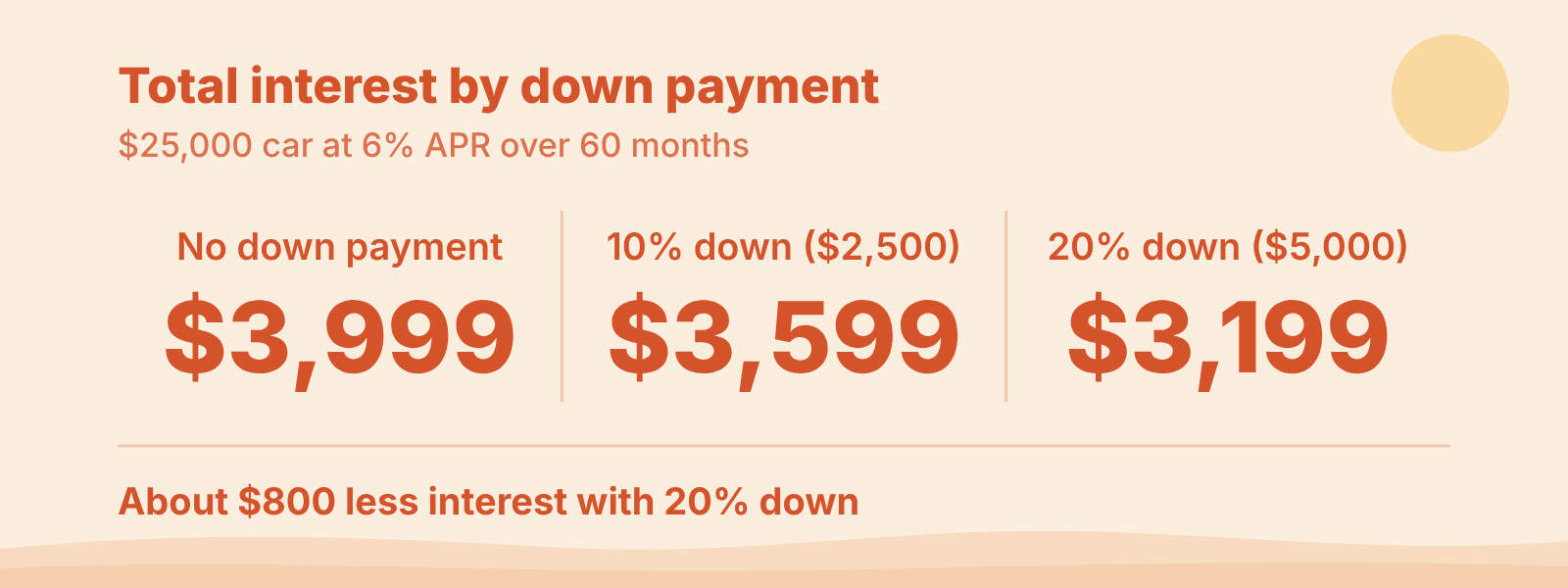
On that $25,000 example at 6% over 60 months, a 10% down payment ($2,500) drops the financed amount to $22,500 and total interest to about $3,599, saving roughly $400 compared to financing the full amount. A 20% down payment ($5,000) brings the financed amount to $20,000 and total interest to about $3,199. The savings compound further if a lower loan-to-value ratio qualifies you for a better rate.
A larger down payment also keeps you out of negative equity territory early in the loan, when the car's depreciation typically outpaces the rate at which you're paying down principal.
Choose a Shorter Loan Term
Term length is one of the most controllable variables in the total cost of a car loan. Every month added to a loan term lowers the monthly payment and raises the total interest paid. The table above shows exactly what that costs across four common terms.
If the monthly payment on a 48-month term stretches your budget, that's worth treating as information about the vehicle's price point relative to your income, not just a financing problem to solve with a longer term.
Stretching to 72 or 84 months to afford a car that's priced above your cash flow means paying the most interest on the most expensive version of the decision.
Keep Add-Ons and Old Balances Out of the Loan
Extended warranties, GAP insurance, paint protection, and similar dealer products all have potential value, but rolling them into your loan means financing them at your loan's APR for the full loan term.
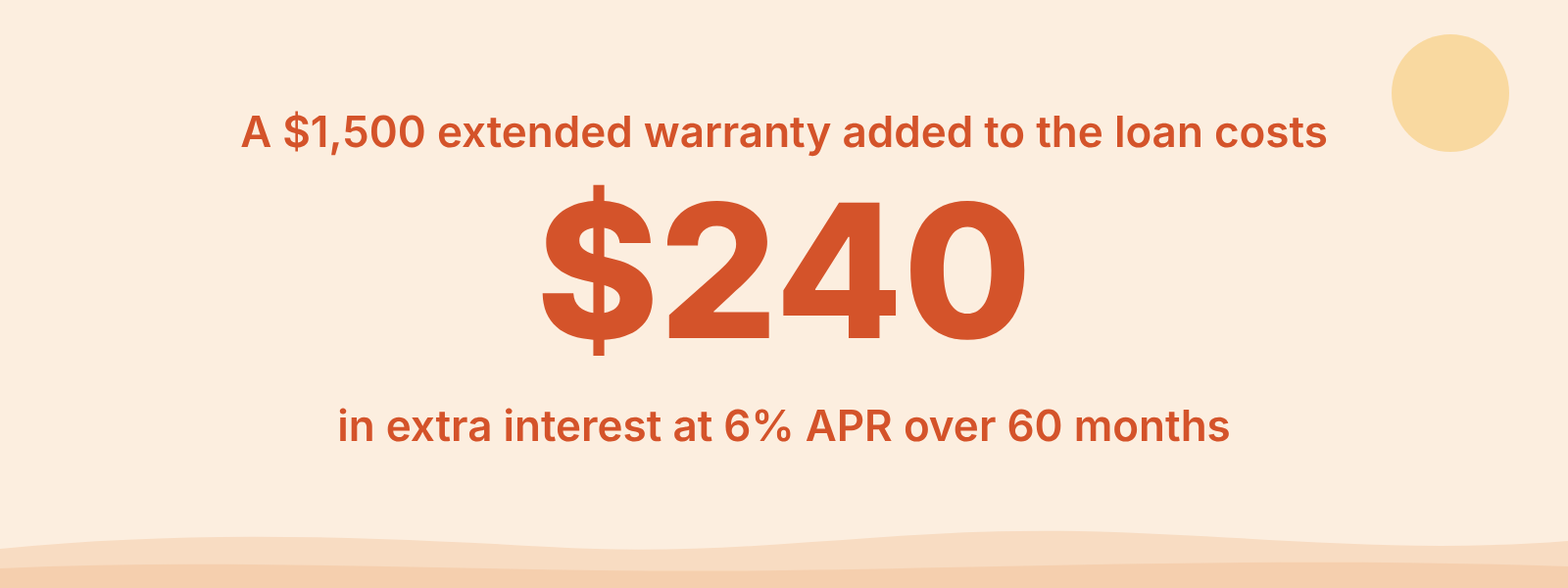
A $1,500 extended warranty added to a 60-month loan at 6% costs roughly $240 extra in interest alone. If you want these products, paying for them separately eliminates that cost.
Trading in a vehicle with negative equity creates a similar problem. If you owe $18,000 on a car worth $14,000, that $4,000 gap typically gets rolled into the new loan, increasing the principal you'll pay interest on.
If you're in that position, it's worth calculating whether paying down the gap before trading in, or waiting until you've built equity, costs less than absorbing the negative equity into new financing.
How to Reduce Interest on an Existing Car Loan
These four approaches apply to loans already in progress, and each works independently of what you did or didn't do before signing.
Make Extra Principal Payments
Paying extra directly reduces your outstanding balance, which reduces every future interest charge. The effect is larger earlier in the loan, when more of the balance remains, but extra payments help at any point.
One critical detail: confirm with your lender how extra payments are applied. Some lenders default to applying them toward future scheduled payments rather than immediately reducing principal.
Request explicitly, in writing, that any additional payment above the minimum be applied to principal. Keep a record of that confirmation.
Pay Biweekly Instead of Monthly
Instead of one full payment per month, you split it in half and pay every two weeks. Because there are 52 weeks in a year, that produces 26 half-payments, which equals 13 full payments instead of 12.
That one extra annual payment reduces principal faster and cuts total interest. On the $25,000 at 6% over a 60-month example, consistent biweekly payments can shorten the loan by roughly three to four months and save around $300 in interest.
Confirm your lender supports biweekly payment structures before setting it up.
Refinance to a Lower Rate
Refinancing replaces your current loan with a new one at a lower rate, ideally with a shorter remaining term. The savings can be substantial if your credit score has improved since you originally financed, or if market rates have dropped.
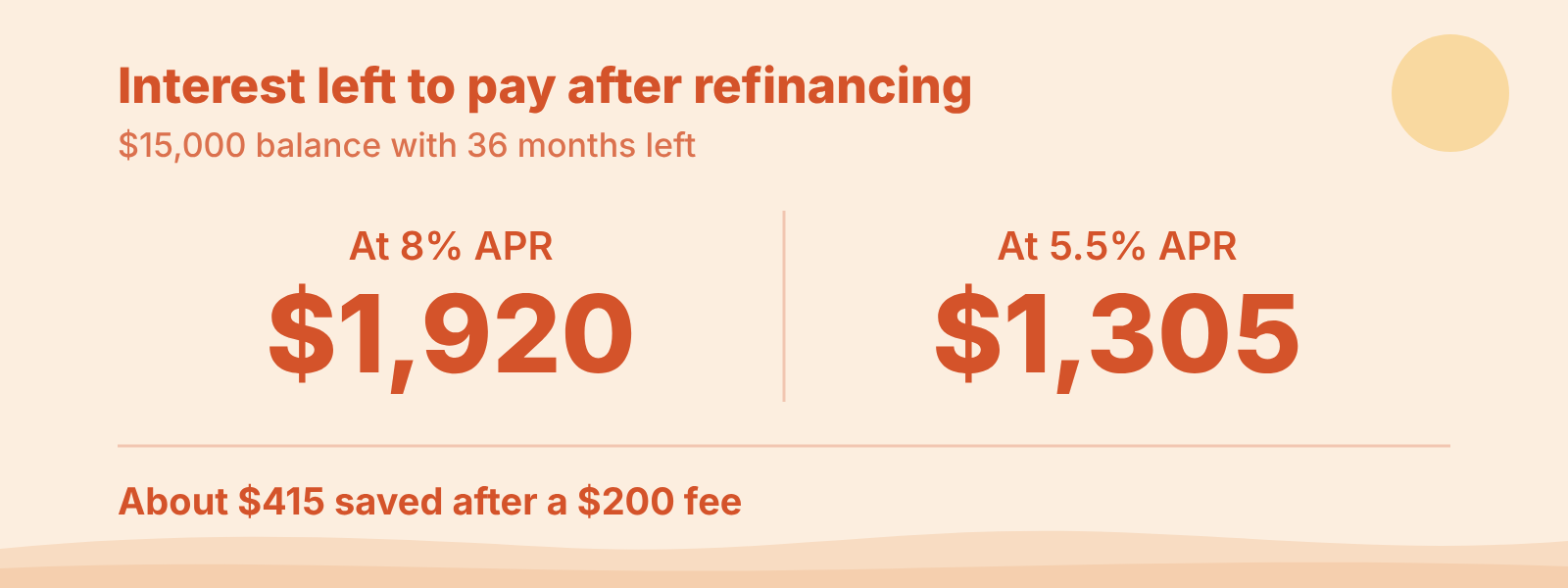
Take a $15,000 remaining balance at 8% with 36 months left. Refinancing to 5.5% drops total remaining interest from roughly $1,920 to about $1,305, a saving of about $615 before fees. With a $200 origination fee, net savings are about $415.
Where you are in the loan term matters. Early on, when the balance is high and payments are still interest-heavy, a lower rate produces the largest savings. Past the halfway point, most of the interest has already been paid, and the case for refinancing weakens considerably.
Check for Prepayment Penalties First
Before making extra payments or pursuing a full payoff, read your original loan agreement and your Truth in Lending Act disclosure. Some lenders charge prepayment penalties triggered by early payoff, and if the penalty exceeds the interest you'd save, the math doesn't work in your favor.
Most modern auto loans don't carry these, but it takes five minutes to check and could change the decision entirely.
Is It Better to Pay Off a Car Loan Early or Invest the Money?
The right answer depends entirely on your interest rate and what else is sitting in your financial picture.
Early payoff makes financial sense when your APR is high. At 7%, 8%, or above, paying down the loan provides a guaranteed return equal to your interest rate, which is difficult to beat reliably with low-risk investments. It also makes sense if you carry no other higher-rate payments and if eliminating the monthly payment would improve your cash flow.
At lower rates, the calculation shifts. The S&P 500 has historically returned an average of roughly 10% annually before inflation over long periods, though with significant year-to-year variation.
A car loan at 3% or 4% represents cheap financing by historical standards, and directing extra cash toward a diversified index fund has historically outperformed paying down that rate. Investment returns are not guaranteed and loan payoff savings are, so risk tolerance matters alongside the math.
Rate aside, early payoff rarely makes sense without an emergency fund in place first. If you don't have three to six months of expenses set aside, paying down a 4% car loan while carrying no cash buffer means optimizing one number while creating real financial exposure elsewhere.
The same logic applies to prepayment penalties: if the fee exceeds the interest you'd save, early payoff costs more than it returns.
How to Make Car Loan Payments Easier to Manage
Reducing interest is one part of managing a car loan well. Staying consistent with payments is the other.
Paychecks often arrive weekly or biweekly. Car payments are due monthly. That mismatch means a large chunk leaves your account all at once, sometimes before the next paycheck arrives.
When the timing is off, even borrowers who are perfectly capable of making their payments face a cash flow squeeze.
The risk isn't the payment itself. It's a timing gap that can lead to a missed or late payment, which costs money in fees and can affect your credit score.
Split Pay handles this automatically. It advances your full car payment to the lender on time, then collects from you in two smaller amounts aligned with your pay schedule. Your lender always sees an on-time payment. No lender approval required, no changes to your loan terms, and no timing gaps.
How to Avoid Interest on a Car Loan: FAQs
1. Can you avoid interest on a car loan completely?
Only in two situations: paying cash outright, or qualifying for a genuine manufacturer 0% APR promotion. Outside those, the goal is reducing total interest through rate, term, and payment decisions.
2. Does paying off a car loan early save interest?
Yes. Interest accrues on the outstanding principal each month, so a lower balance means lower charges going forward. Paying $50 to $100 extra per month from the start of a mid-range loan can save several hundred dollars and cut months off the term.
3. Do extra payments go toward principal?
They should, but not automatically with every lender. Confirm in writing that any payment above the minimum goes directly to principal, and check your statements to verify it's being applied correctly.
4. Is refinancing a car loan worth it?
Compare total remaining interest at your current rate against the new rate, subtract any lender fees, and calculate how many months it takes to break even. The earlier in the loan you refinance, the larger the potential savings, since remaining payments are still interest-heavy.
5. Does paying biweekly reduce car loan interest?
Yes. Paying half your monthly amount every two weeks produces 13 full payments per year instead of 12, reducing principal faster and cutting total interest without increasing individual payment amounts.
6. What is the fastest way to pay off a car loan?
A large down payment combined with the shortest term you can manage at purchase sets the best foundation. For existing loans, consistent extra principal payments beat a single lump sum applied late in the term.
7. What is a prepayment penalty on a car loan?
A fee some lenders charge when a loan is paid off ahead of schedule. Check your Truth in Lending disclosure before making extra payments, since a penalty larger than your interest savings makes early payoff counterproductive.