Does Paying Rent Build Credit? What Renters Should Know

Rent is the biggest payment most people make every month. Whether it does anything for your credit score is a different question entirely, and the answer isn't what most renters expect.
This article explains exactly when rent builds credit, when it doesn't, and what it takes to make your payment history count.
Does Paying Rent Build Credit?
Rent payments can build credit, but only under one condition, which is that someone has to report them to the credit bureaus.
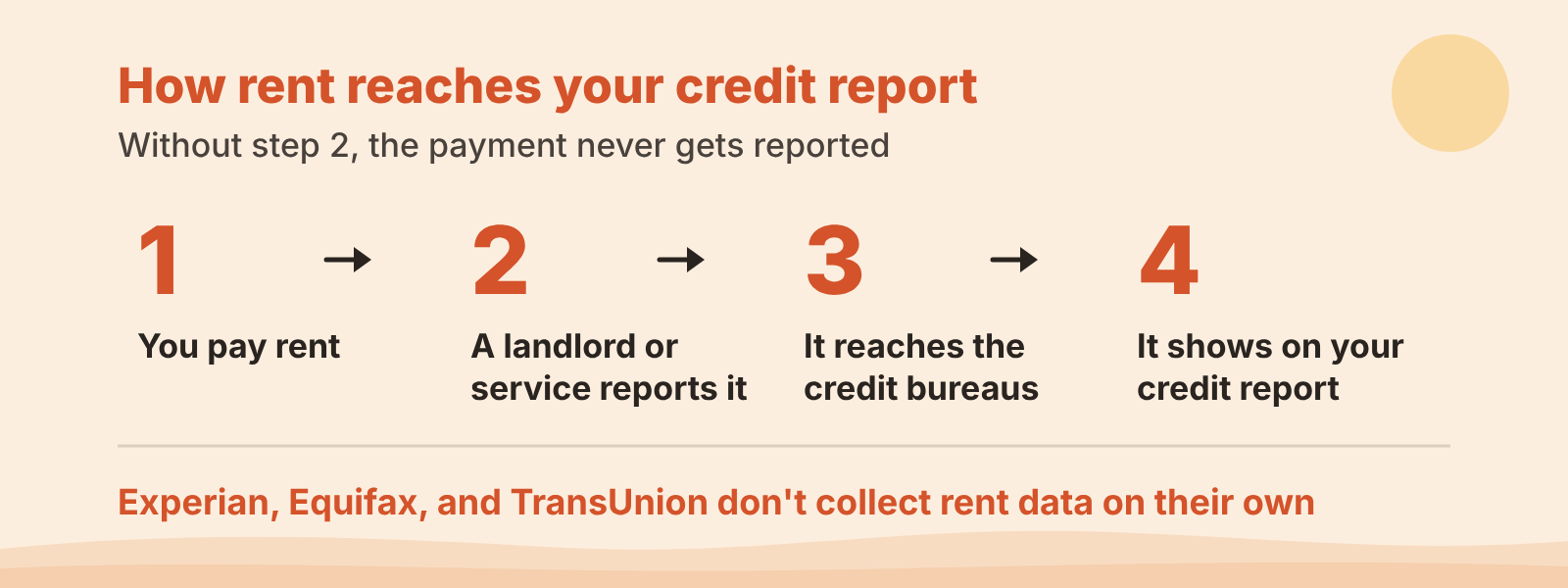
The payment itself, no matter how consistent or on time, does nothing for your credit file unless it's been transmitted to Experian, Equifax, or TransUnion by a landlord or a reporting service.
Credit bureaus don't collect rent data automatically.
When Rent Payments Count
Payments only reach the bureaus when a landlord, property manager, or third-party service sends the data there.
When reporting is in place and payments are made on time, they appear on your credit report as payment history, which is the factor that carries the most weight in how credit scores are calculated.
How much it can move your score depends on the rest of your file, covered in detail below.
When Rent Payments Don't Count
Paying by check, bank transfer, cash, or any other method without a reporting service in place means the payment never touches the credit system. According to the Urban Institute, less than 5% of rent payments are reported to the credit bureaus.
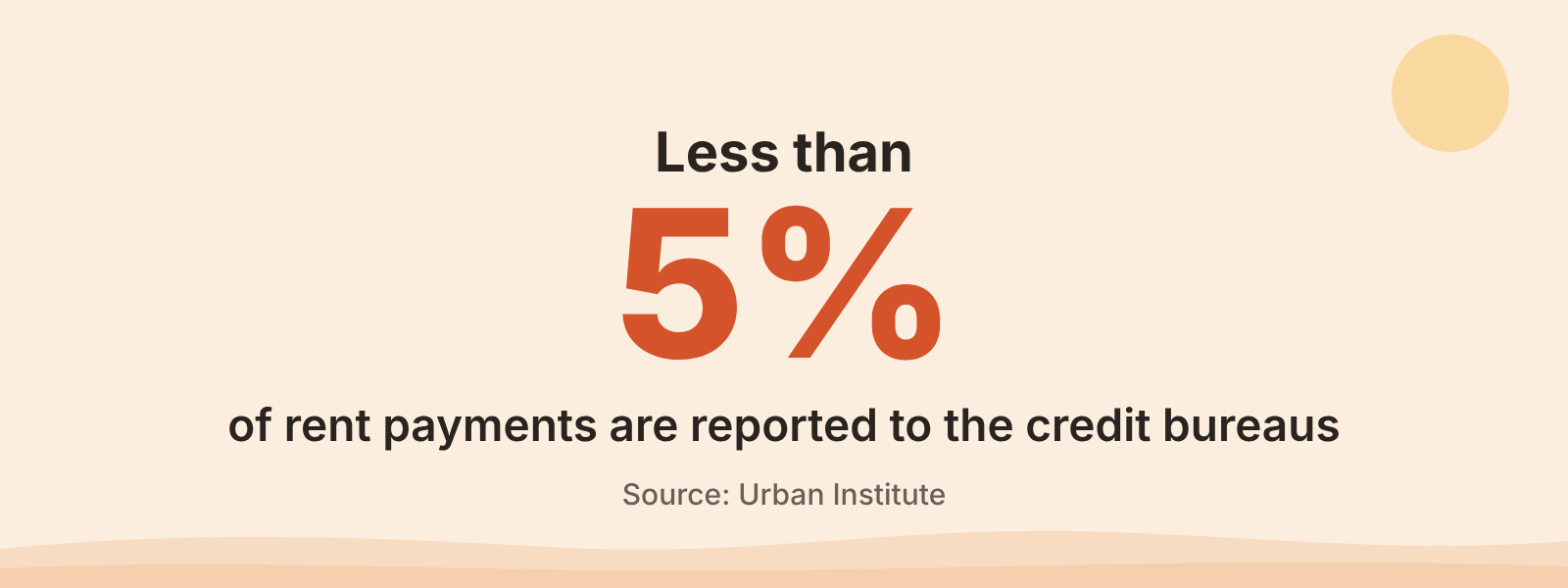
Any payment outside that small share doesn’t appear on your report and has no effect on your score, positive or negative.
How to Report Your Rent to the Credit Bureaus
Reporting doesn't happen automatically. A service has to actively send payment data on your behalf, and setting that up requires either your landlord to already have it in place or you to arrange it yourself.
There are two routes, and knowing which one applies to your situation determines what you do next.
Landlord or Property Manager Reporting
Some landlords and larger property management companies already use a reporting platform as part of how they manage tenant accounts.
If yours does, your on-time payments may already be reaching the bureaus. The only way to confirm is to ask the leasing office directly. Check whether reporting is active and which bureaus they send data to.
Third-Party Rent-Reporting Services
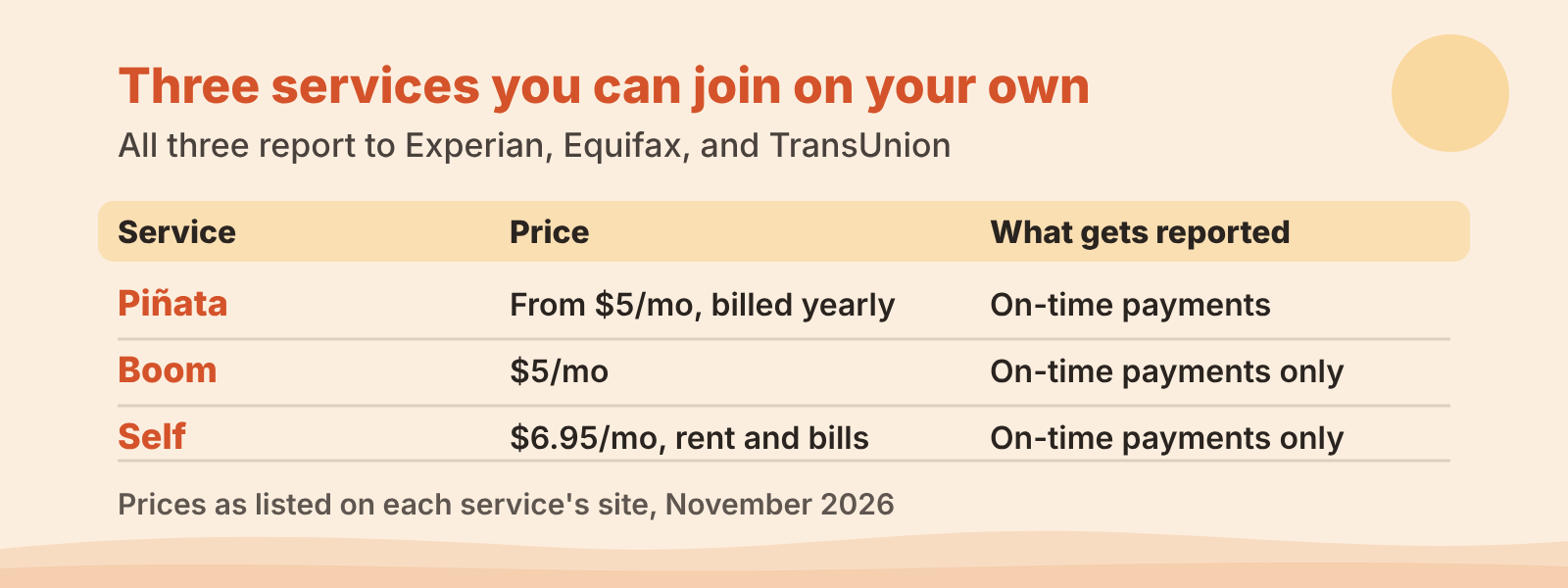
If your landlord doesn’t report, you can set it up yourself through a third-party service. Piñata, Boom, and Self let renters enroll on their own, and all three send on-time rent payments to Experian, Equifax, and TransUnion.
Esusu and RentTrack work differently. Both run through property owners and managers, so you can only use them if your building has already signed up.
Enrollment usually means verifying your identity and your lease, then connecting the bank account you pay rent from so the service can confirm each payment. Each service sets its own steps, so check what it asks for before you sign up.
What to Compare Before You Sign Up
Not every service works the same way, and the differences matter. Some charge a setup fee, a monthly fee, or both, while others are free. Coverage varies, and some report to only one or two of the three bureaus, so favor whichever reaches the ones a future lender is most likely to pull.
If you have a history of on-time payments before enrollment, check whether the service offers back-reporting, since some can add past payments to your file while others only start from the date you sign up.
Confirm whether the service reports late payments alongside positive ones, because if it does, any future timing issue becomes a credit event. Not every building type or payment method qualifies either, so verify eligibility before committing.
How Rent Payments Affect Your Credit Score
Reported rent payments can influence your credit, but the actual effect depends on which scoring model a lender uses and what the rest of your credit file looks like.
Which Credit Scores Count Rent Payments
Not all scoring models treat rental data the same way. FICO Score 9, FICO Score 10, and FICO Score 10T, along with VantageScore 3.0 and 4.0, can incorporate it when it shows up on a report. Many lenders still rely on older versions that ignore it completely. Classic FICO, including FICO 8, the version most widely used by lenders today, does not include rent at all.
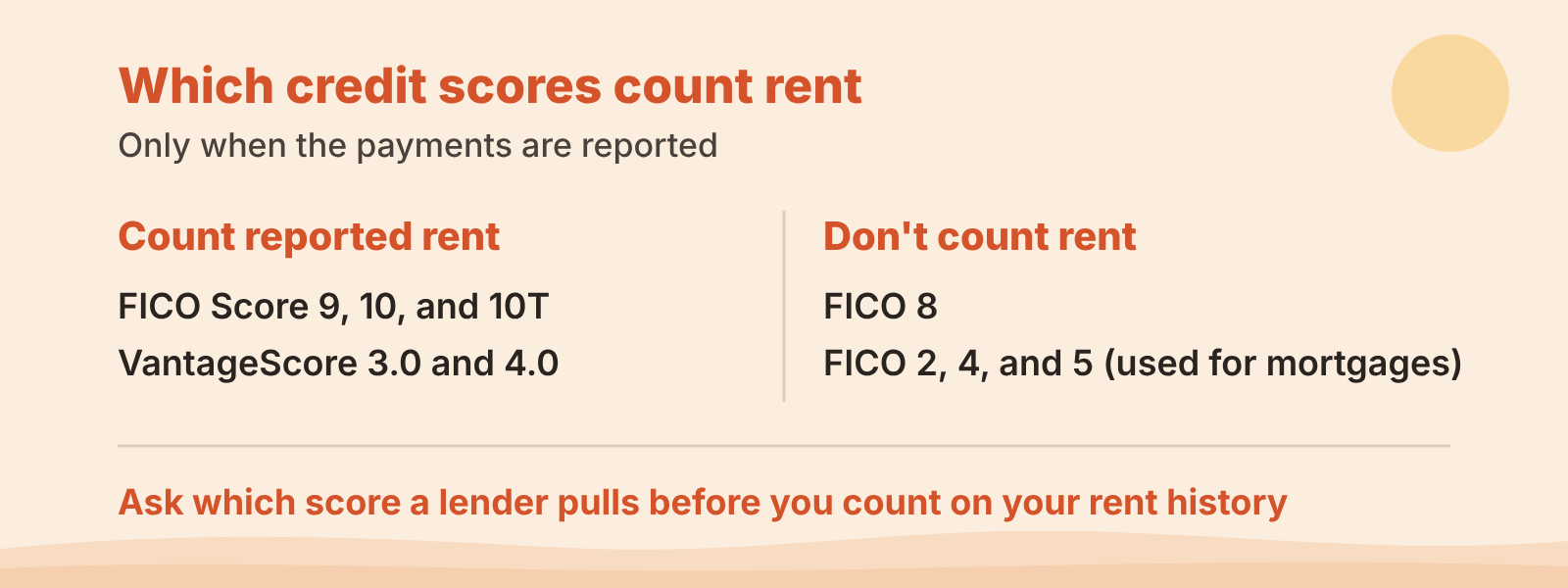
Mortgage lenders, auto lenders, and credit card issuers each choose their own preferred model, and those choices don’t always favor the newest versions. According to FICO, rent payments don’t affect FICO Scores 2, 4, and 5, the versions currently used for mortgages.
A renter with months of reported on-time payments could apply for a loan and have that entire history invisible to the lender, depending on which model they pull.
How Much It Can Move Your Score
Payment history accounts for roughly 35% of a FICO Score, making it the largest single factor in how a score is calculated.
For someone with little or nothing on their credit report, adding a consistently reported monthly payment can be the difference between having a usable score and having none at all.
In an Urban Institute trial with 269 renters in subsidized housing, rent reporting made renters with low or no prior scores 25% more likely to reach a near-prime score.
How much it moves depends on what's already on the file. The more established someone's existing credit history is, the less impact one new account will have. No reporting service can tell you in advance what your number will do.
Can Late Rent Hurt Your Credit?
The answer depends on whether rent is being reported at all.
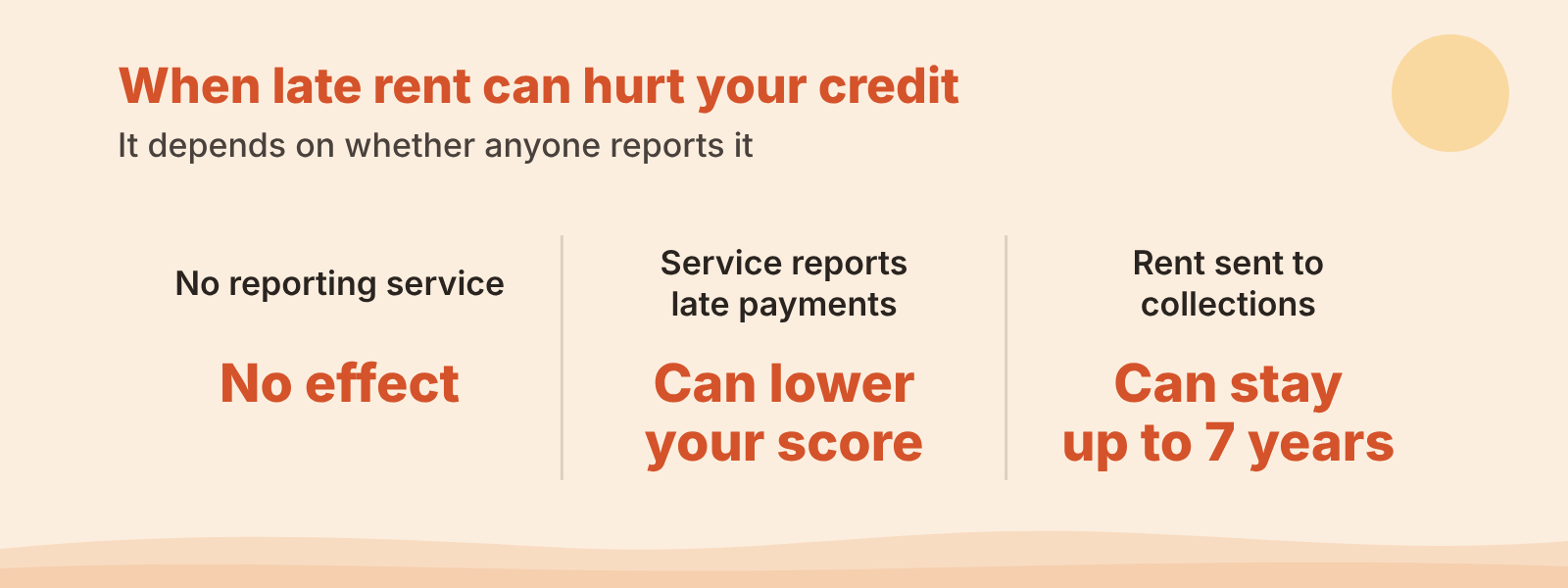
Late Rent vs. Reported Late Rent
Late rent only becomes a credit event if a reporting service is in place. A tenant paying late with no service set up has no credit consequence from that payment.
Once enrolled in a service that includes late payments, missed or late payments can be submitted to the bureaus the same way on-time payments are.
What Happens If Rent Goes to Collections
Unpaid rent handed off to a collections agency can appear on a credit report regardless of whether any reporting service was ever in place, and it can remain there for up to seven years.
Collections accounts carry significant negative weight with scoring models and can affect a score across that entire window.
Other Ways to Build Credit While Renting
Building credit while renting doesn't require a reporting service. Several options work alongside rent reporting or entirely on their own.
A secured credit card requires an upfront deposit that acts as the credit limit. Using it for everyday purchases and paying the balance in full each month keeps costs at zero and adds consistent activity to a credit file.
A starter or student credit card builds credit the same way for those who qualify without a deposit.
Becoming an authorized user on someone else's account is another option. If the primary cardholder has a long record of on-time payments and low balances, being added can bring some of that history onto your own report without requiring you to manage the account yourself.
The account's age, credit limit, and payment history all factor in, so being added to a well-established card with low utilization carries more weight than a newer one. If the primary cardholder's payment behavior changes, that change affects your report too.
A credit-builder loan works differently from a standard loan. Payments go into a secured account throughout the term, those payments get reported to the bureaus, and the funds are released at the end. The point is the reported payment history, not the money itself.
Some services also report other recurring bills such as utilities and phone payments, though bureau coverage and scoring model compatibility vary here just as they do with rent reporting.
Keeping balances low relative to credit limits and checking credit reports regularly for errors or missing accounts reinforces every other step in this list.
Is Reporting Rent Worth It?
It depends on two things: where your credit file stands today and how reliably you can pay on time.
When It May Be Worth It
Those with a thin file, no score, or a history they're rebuilding stand to gain the most from rent reporting.
Adding a consistently reported monthly payment to a sparse credit report can move the needle significantly, and for someone with no score at all, it can be what creates one. On-time payment every month is the non-negotiable condition that makes any of that possible.
The most common reason people miss that condition is that rent falls due before the paycheck arrives. That gap between the due date and payday is a timing problem, and that's exactly what Split Pay is built to fix.
Split Pay lets you divide your monthly rent into two payments aligned with your paydays, so the full amount reaches the landlord on time every month, turning rent reporting into a credit-building tool instead of a liability.
When It May Not Be Worth It
An established credit history with strong scores is unlikely to see meaningful movement from adding rent to the mix.
A healthy file with multiple active accounts already does the work, and one additional tradeline adds little on top of that.
For anyone who isn't confident in their payment consistency, enrolling in a service that reports late payments introduces risk that can outweigh any potential gain.
Does Paying Rent Build Credit? FAQs
1. Does rent automatically show up on your credit report?
No. Credit bureaus have no direct connection to rental payments. Someone has to actively send that data on your behalf, either your landlord or a service you sign up for yourself.
2. How long does it take for rent payments to affect your credit?
Most people see data show up within one to three months of enrolling. Some services take longer depending on how quickly they can verify the lease and establish the reporting relationship.
3. Can you report past rent payments?
Yes, with some services. Back-reporting lets you add historical on-time payments to your file rather than starting from scratch. Not all services offer it, and some charge extra or cap how far back they’ll go.
4. Is rent reporting free?
It depends on the service. Some are free, others charge a monthly fee, a setup fee, or both. The cost difference between services is significant enough that it's worth spending ten minutes comparing before committing.
5. Can you pay rent with a credit card to build credit?
It can work, but not through rent reporting. The payment registers as a credit card transaction, so what matters is how much of your credit limit it uses up. High utilization can pull a score down even when payments are on time. Factor in any convenience fee your landlord charges too, as those add up.
6. Can you report your own rent without your landlord?
Yes. Third-party services are set up for exactly this. You'll typically need to provide proof of your lease and your landlord's contact details for verification, but their active involvement isn't required.