Late Mortgage Payment Credit Score Impact: What Happens When You Pay Late?

Missing your mortgage due date and damaging your credit score are two separate events. There’s a set timeline between them, and many homeowners don’t know how it works.
Here’s when a late payment reaches your credit report, what shapes the damage to your score, how long the mark stays on your file, and what recovery looks like.
How Late Does a Mortgage Payment Have to Be to Affect Your Credit?
Many mortgage servicers give you a grace period, meaning a few days after the due date when you can still pay without a late fee. According to Experian, it’s typically up to 15 days, so a payment due on the 1st can usually go out by the 16th without a fee. Check your loan documents for your exact cutoff.
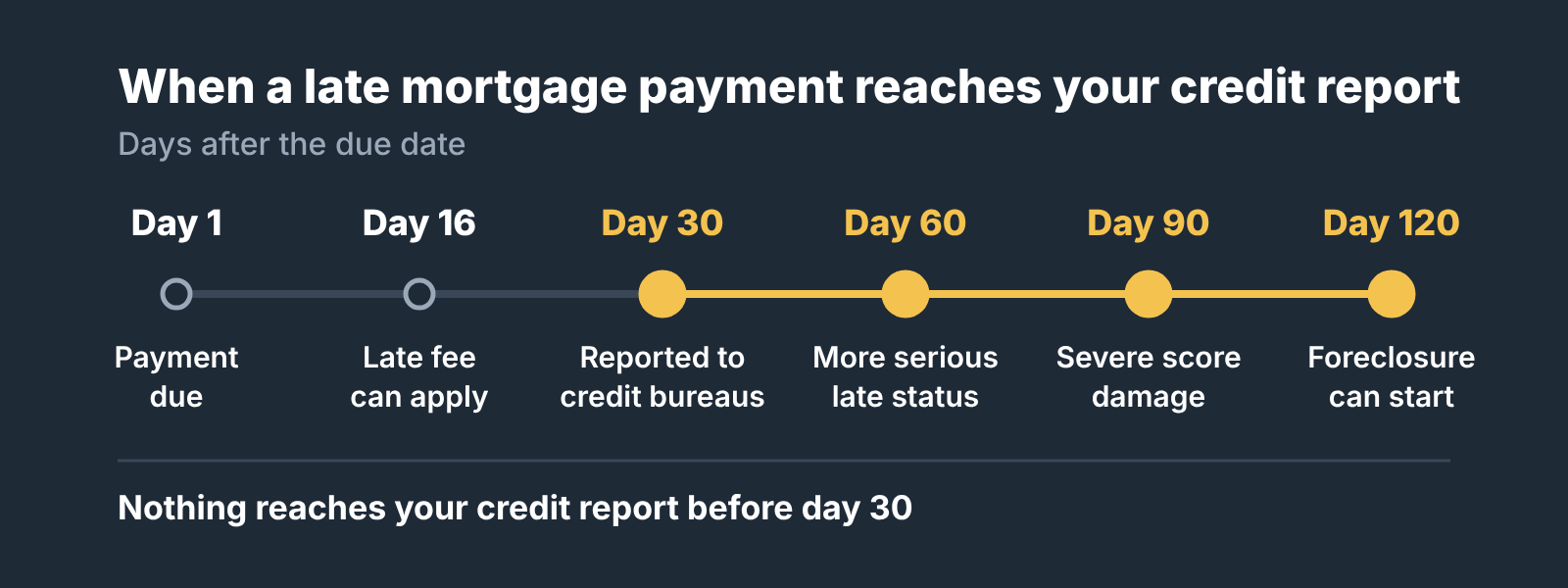
Credit reporting starts later, at 30 days past the due date. That’s the point at which servicers report late payments to the credit bureaus, according to the same Experian guide, so a payment that’s 1, 16, or 29 days late doesn’t show up on your credit report.
For a payment due on the 1st, credit damage can’t start before the 31st. A late fee and a credit report entry are two separate consequences, each with its own trigger.
Less Than 30 Days Late
No credit reporting at all. After day 15, a late fee may apply, but your credit score is untouched. Pay before day 30 and nothing shows up on your credit file.
30 Days Late
Your servicer can now report the missed payment to the credit bureaus. Once it does, a late payment mark appears on your credit file and your score drops, and how far it falls depends partly on where it started.
60 Days Late
The account is now reported as 60 days late, a more serious status than 30, and the damage to your score grows with it.
90 Days Late
Score damage is severe. Depending on your loan agreement and state law, your servicer may begin formal review procedures or pursue legal options at this point.
120+ Days Late
Under federal mortgage servicing rules from the Consumer Financial Protection Bureau (CFPB), a servicer can’t start foreclosure until the payment is 120 days late. Past that point, what started as a timing issue can turn into a legal one.
| Days Late | Late Fee | Reported to Credit Agencies | Potential Credit Impact |
|---|---|---|---|
| 1–15 | No | No | Nothing yet |
| 16–29 | Usually | No | Late fee only |
| 30+ | Yes | Yes | Late mark on your credit report |
| 60+ | Yes | Yes | More serious late status |
| 90+ | Yes | Yes | Severe score damage |
| 120+ | Yes | Yes | Foreclosure can start |
How Much Can a Late Mortgage Payment Drop Your Credit Score?
Three variables drive the size of the drop: your starting score, the depth of your credit history, and whether you've missed payments before.
Borrowers with higher scores usually lose more points from a single 30-day late payment. A missed payment stands out on a clean, long-standing file, and Experian notes the impact is strongest if you’ve never had a late payment before.
The same late payment on a file with earlier ones changes less, since lenders have already seen the pattern.
FICO, the credit scoring company whose scores 90% of top lenders use, according to FICO, doesn’t publish current point-drop figures. Its older example for a 30-day late mortgage payment gives a sense of scale:
- A 780 score fell to roughly 670 to 690.
- A 680 score fell to roughly 600 to 620.
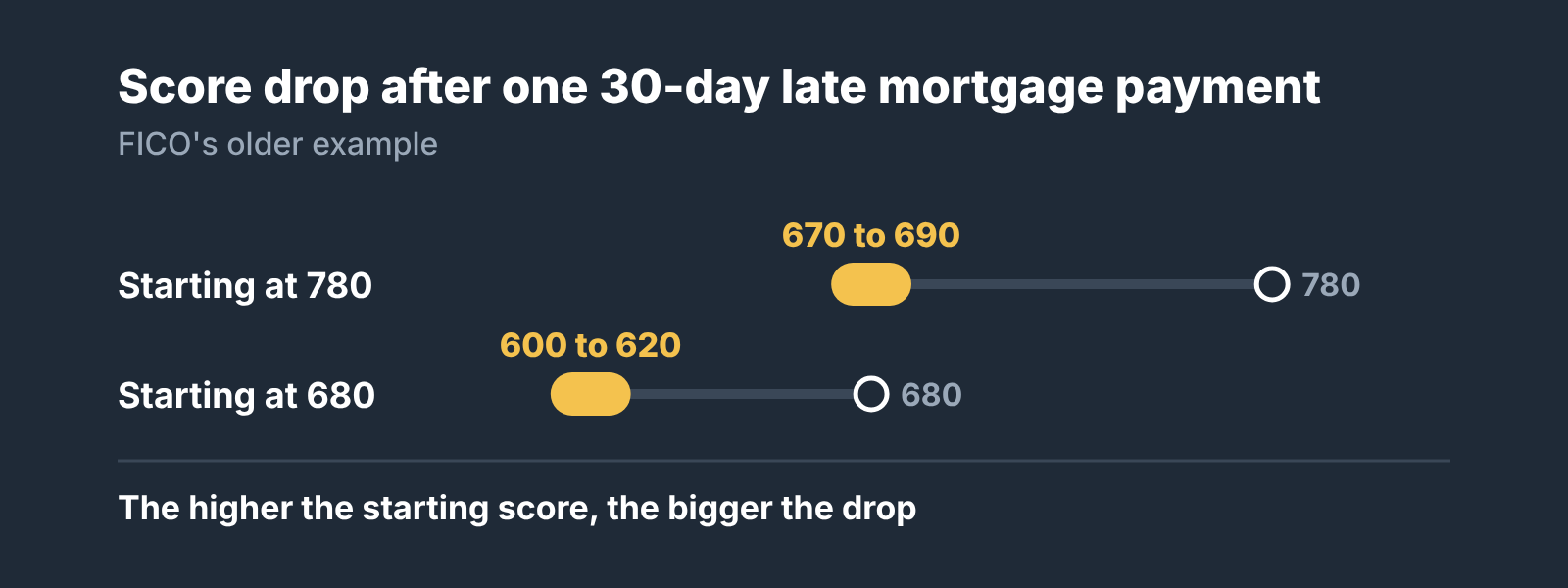
The example is more than ten years old, so read it as a sign of how big the drop can be rather than a forecast for your file. If the payment reaches 60 days late, the reported status gets worse and the damage grows, which is why getting current before the next 30-day mark matters more than the late fee.
Payment history is the largest single factor in a FICO Score, at 35% of the calculation, so one reported late payment weighs on the score until newer on-time payments start to outweigh it.
How Long Does a Late Mortgage Payment Stay on Your Credit Report?
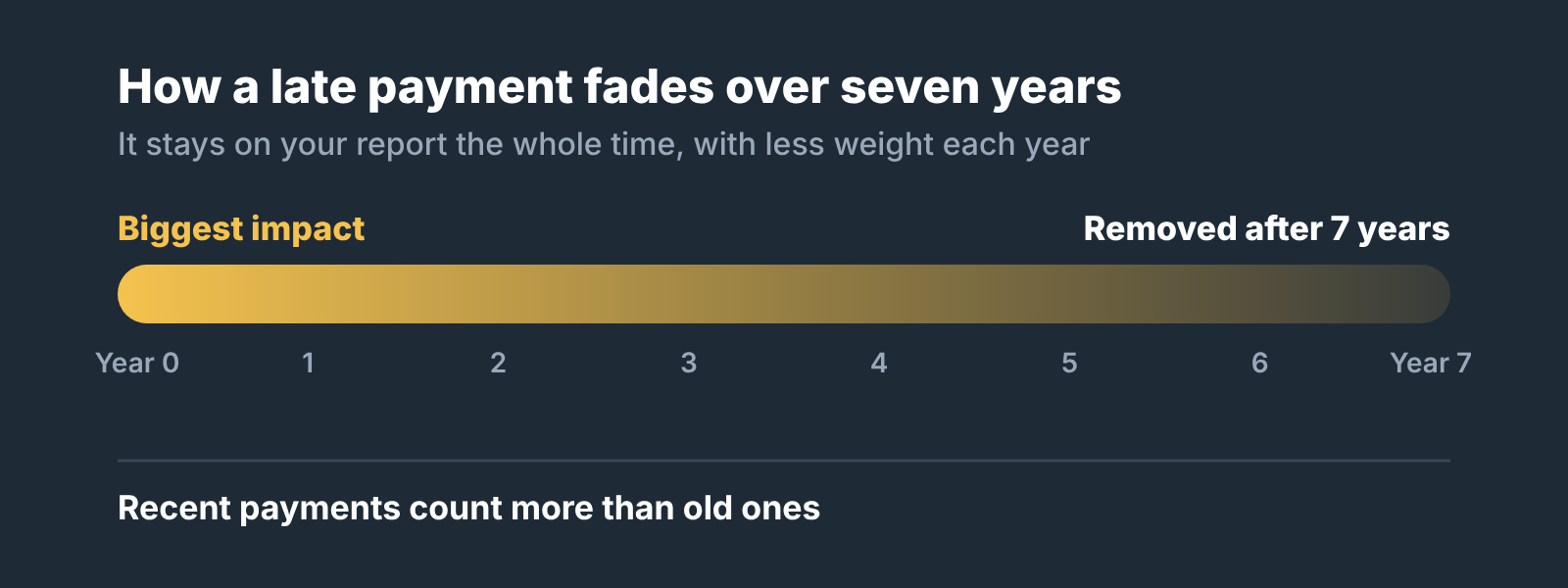
A late payment stays on your credit report for seven years from the date of the first missed payment, a limit set by the Fair Credit Reporting Act (FCRA). The mark stays regardless of whether the account is brought current, refinanced, or paid off entirely. Resolving the balance doesn't change the reporting timeline.
Scoring algorithms weigh recent activity more heavily than older activity. A missed payment from six years ago carries far less influence than one from six months ago, even though both appear on the report.
How fast your score comes back depends on how far it fell and what the rest of your file looks like, and no scoring company publishes a reliable recovery timeline. What helps every file is a long run of on-time payments after the late one.
A second missed payment on any account during recovery sets back how lenders read your file, even as the mortgage mark ages out.
Why a Late Mortgage Payment Can Cost More Than Other Late Bills
Payment history is the largest single factor in a FICO Score, at 35% of the calculation. Neither FICO nor Experian says a late mortgage payment is scored more heavily than another late payment, so the extra cost shows up outside your score, wherever a lender looks at your mortgage history specifically.
Refinancing is where that shows up first. Fannie Mae’s high loan-to-value refinance option, for example, allows no late mortgage payments in the most recent six months and no more than one 30-day late payment in the six months before that, so a single missed payment can close that door for half a year. A lower score also tends to mean higher rates on any new credit you apply for while it recovers.

How to Avoid a Late Mortgage Payment
1. Use Your Mortgage Grace Period
Most servicers allow a 15-day grace period past the due date before applying a late fee. Review your specific lender's cutoff and use this window intentionally if your cash flow is tight in a given month.
2. Contact Your Servicer Early
Lenders have far more flexibility if you contact them before missing a payment. Options that aren't advertised include temporary payment pauses, short-term repayment plans, or moving your permanent due date. Calling on day 25 gives you significantly more leverage than calling on day 35 after a mark is already filed.
3. Set Up Automatic Payments
Autopay removes human error from the equation. Some servicers offer a small rate reduction, typically 0.25%, as an incentive to enroll. It's worth asking about during setup.
4. Use Payment Reminders
If you prefer to submit payments manually, set calendar alerts 7 to 10 days before the due date. That buffer gives you enough time to move funds between accounts without any pressure.
5. Monitor Your Credit Reports
Lender reporting errors happen and can unfairly affect your score. Check your reports for free at AnnualCreditReport.com to catch and dispute any inaccuracies before they become part of your permanent file.
6. Align Payments With Your Pay Schedule
Homeowners rarely miss mortgage payments out of forgetfulness. The real issue is a timing mismatch between the day income arrives and the day the payment is due. A large lump sum due on one fixed date doesn't map cleanly onto a biweekly paycheck cycle.
Split Pay resolves this directly. You split your monthly mortgage payment into two smaller installments that align with your actual pay dates. Split Pay advances the full amount to your lender on time, then collects from you in two parts. Your lender always sees an on-time payment, no lender approval needed, and your loan terms stay exactly the same.
What to Do If You Already Missed a Mortgage Payment
Your next step depends on how many days late the payment is.
If You’re Less Than 30 Days Late
Pay the full amount immediately. No mark has been filed with the credit agencies yet. Getting current before day 30 keeps this off your credit file entirely. If a late fee applies, pay that at the same time to prevent further notices from your servicer.
If You’re More Than 30 Days Late
A mark has likely already been filed, so the focus now is stopping additional ones. Each new 30-day interval adds a separate entry, and that's where the score damage compounds most sharply. Contact your servicer's payment assistance team directly, not standard customer service. That team has access to repayment plans and options that aren't available through regular channels.
If Payments Are Consistently Difficult
Federal mortgage servicing rules require your servicer to present available options before moving toward foreclosure. Those options include loan modifications, extended payment pauses, and repayment plans spread over 6 to 12 months. Put every agreement in writing. Verbal agreements with servicers are difficult to enforce.
Can You Repair the Damage After a Late Mortgage Payment?
Yes. If you're still inside the 30-day window, pay now. The mark hasn't been filed yet and getting current today keeps it off your credit file completely.
If that window has closed, here's what to do.
Request a goodwill adjustment. Write to your servicer and ask them to remove the entry. Include your account history, what happened, and what you've done since. Not guaranteed, but servicers do grant these for borrowers with one isolated event on an otherwise clean file.
Dispute any errors. If the entry has factual mistakes, wrong date, wrong number of days, incorrect amount, file a dispute directly with each credit agency. Servicers are legally required to investigate and correct genuine errors. Accurate entries reported correctly cannot be removed this way.
Keep credit card balances low. Staying below 30% of your available limit sends a positive signal to scoring models and is one of the fastest levers available during recovery.
Stay current on everything else. Consistent on-time payments across all accounts reduce the weight of the missed mortgage payment over time, even while the mark remains on your file.
Most borrowers see noticeable improvement within 6 to 12 months. Full recovery typically lands around two to three years, depending on how far the score dropped initially.
Late Mortgage Payment Credit Score Impact FAQs
1. Does a late mortgage payment affect your credit score?
Not until it hits 30 days late. Anything under that has no effect on your score at all.
2. How many points does a mortgage late payment lower your credit score?
It depends on your starting score. In FICO’s older example, a 780 score fell to roughly 670 to 690 after a 30-day late mortgage payment, while a 680 score fell to roughly 600 to 620, and a high score on a clean file usually falls the furthest.
3. Will a payment 15 days late hurt my credit?
No. Days 1 through 15 fall inside the standard grace period. Days 16 through 29 may carry a late fee from your servicer, but your credit score is still completely unaffected.
4. What happens if I’m 30 days late on my mortgage?
Your servicer can report the missed payment to all three major credit agencies, and most do quickly. That mark can stay on your file for up to seven years.
5. How long do mortgage late payments stay on a credit report?
Seven years from when the payment was first missed, under the Fair Credit Reporting Act. Its effect on your score shrinks over time as positive payment history builds around it.
6. Can a lender remove a late payment from my credit report?
Only if they choose to. A written goodwill request with a strong payment history behind it improves your chances, but there's no obligation on their part.
7. Is one late mortgage payment a big deal?
The initial score drop is real. What matters most is what comes after it. One missed payment followed by 12 or more months of clean payments carries far less weight with lenders than the drop suggests. Most lenders distinguish between a single event and a pattern.