Can I Split My Mortgage Payment Into Two Payments? Everything You Need to Know in 2026

Your paycheck lands every two weeks. Your mortgage lands once a month. The math works on paper, but the timing doesn't always feel that way. One big payment hitting on the wrong Friday can throw off the whole month.
So you start wondering, can I just split the payment in half?
That one question is really two separate questions. There's the schedule, meaning when you pay. And there's the setup, meaning how you arrange it. Mix them up and you can easily end up with an arrangement that doesn't actually fit what you were trying to solve.
Can I Split My Mortgage Payment Into Two Payments?
Yes. Most homeowners can split a mortgage payment into two. The right approach depends on what you're trying to accomplish and who you're working with.
Two questions shape the answer:
- 1.What schedule fits your goal - biweekly, semi-monthly, or something managed on your own side?
- 2.How is it set up - directly with your lender, or through a service that handles it for you?
Whether your lender supports the first option varies. Some servicers offer biweekly programs. Others charge for them or refuse partial payments outright.
Why Monthly, Biweekly, and Semi-Monthly Aren't the Same Thing
Three mortgage payment structures that sound similar can produce very different results. The key variable is whether the schedule follows the calendar of months or the calendar of weeks. That small distinction changes everything, including how much interest you pay over the life of the loan.
Monthly Payments
The standard arrangement. One full payment each month on a fixed due date. Twelve payments a year.
Predictable and easy to plan around. The downside is that your entire housing cost lands at once, which can tighten the days around it, especially if you're paid every two weeks or your income is uneven.
Example using a $400,000 mortgage at a 6.5% interest rate over 30 years (based on realistic US rates in 2026):
Biweekly Payments
Half the monthly payment, paid every two weeks on a fixed weekday, like every other Friday. The schedule follows the calendar of weeks, not months.
A year has 52 weeks. That creates 26 half-payments, which equals 13 full monthly payments instead of 12. That additional payment goes directly toward the principal amount and shortens the loan, but only if the lender processes the arrangement as a true biweekly schedule and applies the extra amount correctly.
Example using the same $400,000 mortgage at 6.5%:
- About $1,264 every two weeks
- Most months total roughly $2,528
- Twice a year, a month contains three biweekly payment dates, bringing the total closer to $3,792
- About $32,870 a year across 26 half-payments
- The extra $2,528 each year goes directly toward principal
- The loan finishes around year 24 instead of year 30
- Total interest drops from roughly $510,000 to closer to $395,000, a savings of around $115,000
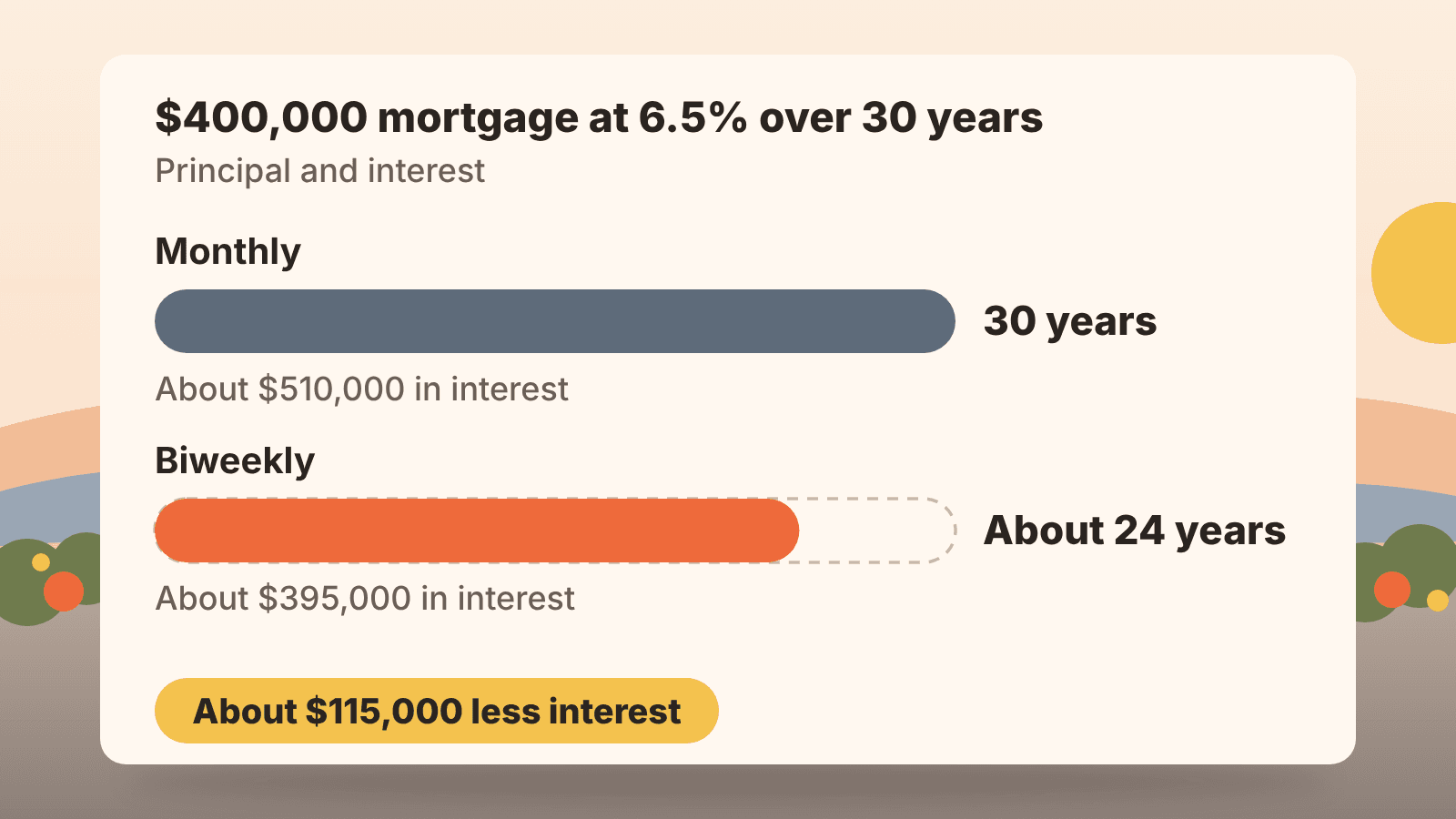
For most of the year, the cash flow feels similar to monthly payments, with two slightly heavier months. The interest savings come from that 13th payment reducing principal earlier than the original schedule expected.
Semi-Monthly Payments
Half the monthly payment, paid on two fixed dates each month, like the 1st and the 15th. The schedule follows the calendar of months, not weeks.
That creates 24 half-payments a year, which equals exactly 12 full monthly payments. No extra annual payment. No change to the loan term. No interest savings.
The benefit is purely about cash flow. One large payment becomes two smaller ones spread across the month.
Example using the same $400,000 mortgage at 6.5%:
- About $1,264 on the 1st and $1,264 on the 15th of each month
- Roughly $30,340 a year across 24 half-payments
- Around $510,000 in interest, the same as monthly
- Approximately $910,000 total over the life of the loan
- The loan ends in year 30, exactly as scheduled
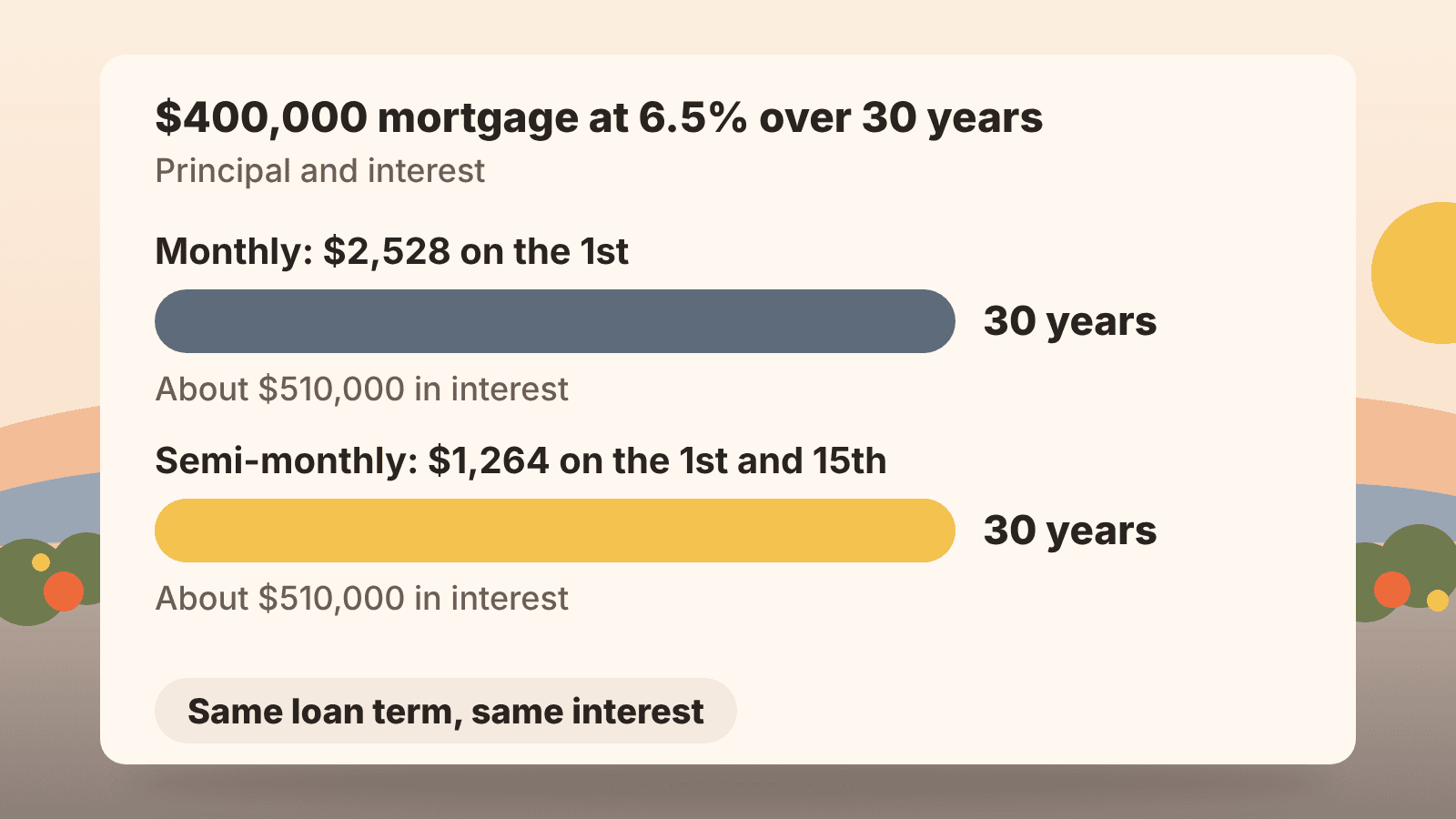
The total paid is identical to the monthly schedule. The loan math doesn't change. What changes is how the payment fits inside the month.
The important distinction is that biweekly and semi-monthly sound interchangeable in everyday conversation. They're not. Biweekly follows the calendar of weeks and creates 26 payments a year. Semi-monthly follows the calendar month and results in 24 payments a year. Only biweekly shortens the loan.
The Two Setup Methods
There are two main ways to arrange the split.
1. Directly With Your Lender
You ask your servicer to switch you to a biweekly or semi-monthly schedule. Some lenders support this automatically, others charge enrollment fees, or refuse partial payments entirely.
The advantage is that everything stays inside the lender's system, including any extra annual payment toward principal through a true biweekly arrangement. The drawback is that it only works if the lender supports it.
Two important pitfalls to watch for:
- 1.Some lenders hold half-payments in a suspense account until the full monthly amount arrives, then post it as a single payment. If that's happening, there may be no real interest benefit from paying biweekly. You're effectively just prepaying yourself.
- 2.Older loans sometimes include prepayment penalties. They're less common now, but still worth checking before increasing payment frequency.
Always confirm in writing how partial payments are applied and whether additional amounts go toward principal or interest. This is the only setup method that creates meaningful interest savings, and only when a true biweekly schedule is actually in place.
2. Through a Split-Payment Service
A third-party service handles the split on your side. Your lender still receives one full payment on the due date. You pay the service in two installments.
This approach works when the lender will not support a biweekly schedule, when income varies month to month, or when you simply need to make the month feel easier to manage rather than paying the loan off faster.
Nothing changes on the lender's side. The mortgage still gets paid the same way each month.
A split-payment service solves cash flow timing, not interest. The lender still receives one standard monthly payment, so the loan term and total interest stay exactly the same.
What you get back is more breathing room between paychecks and bills.
Split Your Mortgage With Split Pay
Split Pay turns one large mortgage payment into two smaller scheduled payments on your side. No lender approval needed. No risk of half-payments getting stuck in a suspense account. No enrollment paperwork with your servicer.
You set the autopayment schedule once, and it runs automatically.
Built for homeowners paid every two weeks, freelancers with uneven income, and anyone whose paycheck calendar does not naturally line up with their mortgage due date.
Why People Actually Want to Split a Mortgage
There are usually four motivations behind it:
- 1. Aligning the mortgage more naturally with biweekly paychecks, so a single paycheck does not have to absorb the entire housing cost at once.
- 2. Smoothing cash flow for freelancers, contractors, and anyone with uneven income, where the timing of money coming in does not always match the timing of money going out.
- 3. Reducing the psychological weight of one large monthly withdrawal. Two smaller payments often feel easier to manage than one large one, even when the total amount stays the same.
- 4. Interest savings and a faster payoff through a true biweekly arrangement with the lender.
The first three are about timing and cash flow. Only the fourth creates meaningful interest savings. For most homeowners asking this question, the first three are usually the real motivation.
Matching the Method to Your Goal
The right setup depends on what you are actually trying to solve. Here are three clear paths:
- 1. Biweekly through the lender works best for homeowners focused on paying the mortgage off faster, but only when the servicer supports a genuine biweekly program.
- 2. Semi-monthly through the lender is more suited to households trying to align the mortgage more naturally with paychecks landing on the 1st and 15th, without expecting interest savings.
- 3. A split-payment service tends to make the most sense when the lender will not support alternative schedules, income varies, or one large payment is putting too much pressure on the month.
6 Mistakes People Make When Splitting a Mortgage Payment
1. Confusing biweekly with semi-monthly
The terms sound interchangeable in everyday conversation, but biweekly creates 26 payments a year and shortens the loan, while semi-monthly creates 24 and does not.
What to do: Confirm which schedule the program is actually offering before signing up. The word “biweekly” by itself is not enough.
2. Assuming any split automatically saves interest
Interest savings only happen when the additional 13th annual payment goes directly toward principal. A split on your side, where the lender still receives one standard monthly payment, does not change the underlying loan math.
What to do: Expect meaningful interest savings only from a correctly applied lender-managed biweekly arrangement. Everything else is primarily about timing and cash flow.
3. Missing the due date because the second half didn't clear in time
Scheduling the second half on the due date itself leaves very little margin for weekends, holidays, or bank processing delays.
What to do: Schedule the second payment to clear several business days before the due date.
4. Paying enrollment fees that wipe out the savings
Some biweekly programs charge enrollment fees or recurring processing fees that gradually eat the interest savings the arrangement is supposed to deliver.
What to do: Compare the projected savings against the total cost of the program before enrolling. If it eats away the gains, the program isn't worth it.
5. Not confirming how the lender applies partial payments
Some lenders hold partial payments in a suspense account until the full monthly amount arrives, then apply it as a single payment. If that happens, there is zero interest benefit.
What to do: Ask the servicer in writing how partial payments are applied before changing the schedule.
6. Not checking for prepayment penalties on older loans
Less common on modern mortgages, but some older loans still include penalties for paying principal down faster than originally scheduled.
What to do: Review the original loan terms or contact the servicer before increasing payment frequency.
Can I Split My Mortgage Payment Into Two Payments FAQs
1. Is it better to pay my mortgage twice a month or biweekly?
That depends on the goal. Biweekly creates 26 payments a year, which effectively adds one extra annual payment and shortens the loan term.
Twice a month (or semi-monthly) creates 24 payments and is usually used to align the mortgage more naturally with fixed paycheck dates.
Choose biweekly for faster payoff. Choose semi-monthly for smoother paycheck alignment.
2. Does splitting my mortgage payment affect my credit score?
No, as long as the lender receives the full required payment by the due date.
Credit scoring is based on whether payments are made on time, not how the homeowner structures the payments internally.
3. How much can I save by paying my mortgage biweekly?
On a typical 30-year mortgage, a biweekly arrangement can shave roughly five to seven years off the loan and save well into six figures in interest.
For example, on a $400,000 mortgage at 6.5%, a biweekly schedule could reduce interest costs by approximately $115,000 while shortening the payoff timeline by around six years.
The exact savings depend on your loan balance, interest rate, and how early the loan schedule begins. Run your numbers through any biweekly mortgage calculator.
4. What happens if one half of my split mortgage payment is late?
If the lender doesn't receive the full monthly amount by the due date, the mortgage counts as a late payment, regardless of how you divided the payments internally.
That's why scheduling the second half a few business days before the due date really matters.
5. Can I switch back to monthly payments later?
Yes, in most situations. Lender-managed biweekly programs can usually be canceled and returned to a standard monthly schedule.
If a split-payment service is being used, the autopayment schedule can normally be adjusted or stopped on the homeowner’s side. Nothing about splitting is a permanent commitment.